


















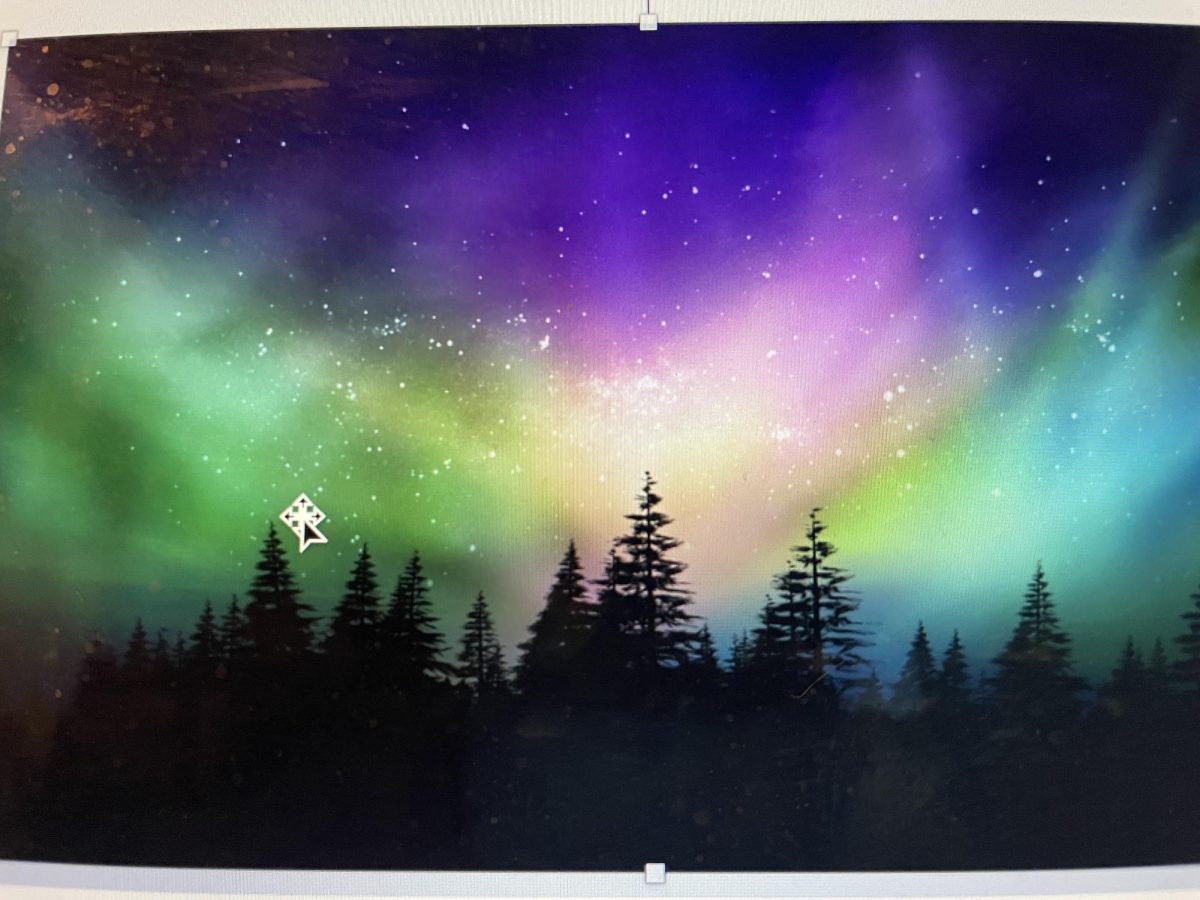
This month, if you looked up north into a clear night sky, you might’ve seen streaks of colors ranging from bright green to a dark pinkish-red. Aurora Borealis, or more commonly known as the Northern Lights, were seen throughout the US this fall from states ranging from the south, such as Alabama, Texas, New Mexico, and Florida, to all over the north in places like New York, the Dakotas, Washington State, and here in New England!
Now, the Northern Lights are beautiful, but what is the main reason why they are present in the night sky? The production of the Aurora Borealis starts with the sun. The sun produces a large amount of charged particles that travel throughout the solar system, which are called solar wind. When this solar wind comes within around 400 to 100 kilometers of Earth, it hits Earth’s magnetic shield, which is produced by molten iron in Earth’s core. Here they accumulate and release energy. This energy, which is the particles released, is light, which here on Earth we see as the Northern Lights.
The Aurora Borealis can appear in a wide array of different hues. What causes them to have different colors? When these charged particles are flying into Earth’s atmosphere, they hit different gases. These gases give the charged particles energy that alters the color of the light produced by the charged particles. The color depends on which gas the particles hit and the altitude at which the particles hit, determining the aurora’s color. For example, when a particle is around 200 kilometers above Earth’s surface and hits an oxygen molecule, the particle will then glow red. For a particle to glow blue or green, it would have to be between 200 to 100 kilometers and hit a nitrogen atom or an oxygen atom, respectively.
So, if you have any free time this fall, make sure to look up into the sky, and you might see a beautiful display of astronomy.